Inside this article
Introduction
Many people approach online trading with the wrong idea: open an account, choose a financial instrument, click buy or sell and try to make money from market movements.
Seen this way, it seems simple. The problem is that online trading is not a fast-paced prediction game and it is not an automatic way to make money. It is an activity in which every decision exposes capital to areal risk.
Those who start from scratch often only look at the possible profit. He sees a chart going up, a crypto exploding, a stock making headlines, a forex pair moving fast. But behind every trade there are variables that a beginner tends to underestimate: market direction, volatility, leverage, spreads, commissions, stop loss management, position size, and emotional control.
Understandwhat online trading is means first of all to understand this: you are not simply buying or selling. You're making decisions under uncertainty.
That's why, before using real money, you need a clear basis. It's not enough to know where to click. You have to understand what you are doing, why you are doing it, how much you can lose if the operation goes wrong and how to assess whether a decision was correct or impulsive.
The probroyal motto
The main problem of those who start is not the lack of information. Today, information is everywhere. The real problem is that a lot of information is absorbed without method.
A beginner can watch videos, read posts, follow signals, try indicators, and open a demo or real account within minutes. But that doesn't mean you're ready to trade.Online trading consists of trading the financial markets through a digital platform. The trader can buy or sell financial instruments trying to benefit from a price movement. If you think the price may go up, you can open a long position. If you think the price may go down, you can open a short position.
But this definition alone is incomplete. The point is not just to enter the market. Point is sopen:
- because you enter;
- where the idea is invalidated;
- how much you risk;
- which scenario is being followed;
- what will be done if the price goes against;
- what will be done if the price goes in favour;
- how the operation will be evaluated after closing.
Without these questions, trading becomes reaction. The trader sees a movement and chases it. He sees a loss and tries to recover. He sees a win and increases the risk. See an f-charthermo and still look for an operation.
This is where the real problem arises: the beginner thinks he has to learn to predict the market, but first he should learn to manage his own decisions.
The markets do not move to confirm the trader. They can climb, descend, stay sideways, make false breakouts, hit a stop and then start again in the expected direction. If the trader does not have a process, each movement looks like a signal. And when allseems like a signal, the risk of operating badly increases.
Why
It happens because online trading is accessible, fast and seemingly simple. All you need is a platform, an internet connection and a trading account. This technical ease makes the decision-making part seem easy too, but they are two very different things.
Buying or selling is simple. Doing it judiciously is difficult.A beginner often confuses market access with market expertise. Just because you can open a trade doesn't mean thattrade has logic.
The most common causes are different.
The first is the wrong expectation. Many start by thinking that trading is mostly a matter of finding the right indicator, the perfect strategy, or the best signal. In fact, a strategy can also have ifnso, but if misapplied it can produce poor results.
The second is the lack of risk management. Those who start from scratch often think about the possible gain and not about the acceptable loss. This is a serious mistake, because in trading loss is not a rare event. It's a normal part of the business.
The third is impulsivity. The trader sees the price moving and feels that he has to enter immediately. Afraid of losing the occasisone. This fear can lead him to open trades with no confirmations, no clear stop and no exit plan.
The fourth is the absence of revision. Many traders close one trade and move on to the next. They do not record why they entered, what they respected, what they did wrong, what emotion influenced the decision. In this way they accumulate experience, but not learning.
The fifth is overconfidenceafter some positive results. A series of winning trades can make you think you understand the market. But often, especially in the beginning, profit can also come from luck, overexposure, or temporary favorable conditions.
The point is simple: online trading puts the trader in front of quick decisions, real money and emotional pressure. Without a method, the platform becomes just a place to turn emotions into operationsion/ Common Mistakes /
The mistakes of the beginner are not always obvious. Some seem normal, others even seem logical. The problem is that repeated over time can damage the account and operating mentality.
- Start with real money too early
The demo account may seem boring, but you need to understand the platform, test a logic and learn how to perform without financial pressure. Go tothe real one, without knowing how to manage stops, lots and risk, exposes us to avoidable errors.
- Just think about how much you can earn
A trade should not only be valued by the potential profit. It must also be evaluated by how much it can lose, where the stop is located, the risk/return ratio and the quality of the setup.
- Using too high a lever
Leverage allows you to control positions larger than the available capital. This can bemultiply the results, but also the losses. For a beginner, using leverage without understanding it is one of the most dangerous mistakes.
- Enter because the price "seems to go up"
A strong movement is not automatically a good entry point. Sometimes the trader enters just when the movement is already extended and the risk of retracement increases.
- Change your mind during the trade
Many come in with a plan, then modify it whenthe price moves against. They move the stop, close too early, increase the position, or turn a short trade into a long hope.
- Failure to distinguish trading and investing
Investing often means building exposure over time on instruments chosen with a long-term logic. Trading means trying to manage price movements over shorter horizons, with precise operating rules. Confusing the two things poleads to inconsistent decisions.• Follow signals without understanding the reason
A cue may indicate an idea, but it is not a substitute for reasoning. If the trader does not know why he enters, where he exits and how much he risks, he is delegating responsibility without building competence.
- Do not track transactions
Without an orderly historian, the trader doesn't really know what they're doing. Can remember winnings, forget mistakes and have a distorted perception of their own performance.
What to do in practice
To get started the right way, the first goal doesn't have to be earning right away. It must be learning to operate with structure.
A practical basis can start from a few simple rules.
Before opening a trade, the trader should know which instrument he is trading. In online trading there are several markets:
- Forex: currency market, where pairs such as EUR/US are tradedD, GBP/USD or USD/JPY.
- Shares: shares of listed companies, such as technology, industrial or financial companies.
- Crypto: Digital assets such as Bitcoin, Ethereum and other cryptocurrencies, often very volatile.
- Indices: instruments related to the performance of stock baskets, such as American, European or Asian indices.
- Commodities: Instruments linked to gold, oil, natural gas, silver and other physical assets.
Each market has characteristichand different. Forex can move a lot on macroeconomic news. Cryptocurrencies can have high volatility even without obvious events. Stocks can be influenced by quarterlys, balance sheets, and company news. Indices often reflect the general sentiment of the market. Commodities can react to economic data, geopolitical tensions, and global demand.Once you understand the tool, you need a risk rule. A useful question is: if this trade goes bad, how much am I willing to lose?
This question comes before profit. If the trader does not know how to define the maximum loss, he is not checking the trade. He's having it.
A minimum structure before entering can be this:
- expected direction: long or short;
- reason for entry;
- admission price;
- st levelop loss;
- output target;
- maximum risk on the operation;
- conditions that invalidate the setup;
- dominant emotion before entering.
This checklist does not make the trade win. It serves to make the decision more controlled. In trading, a good decision can still close at a loss. A bad decision can also close in profit. The point is to learn to distinguish the result from the process.
A traderbeginner should also avoid trading on too many instruments at the same time. Better to know few markets well than to jump every day from forex to crypto, from gold to stocks, from indices to commodities without a logic.
In the beginning it is more useful to build habits than to look for complexity. A simple routine can be:
- analysis before opening the trade;
- definition of the risk;
- execution only if the conditions sto be respected;
- recording the transaction;
- review after closing;
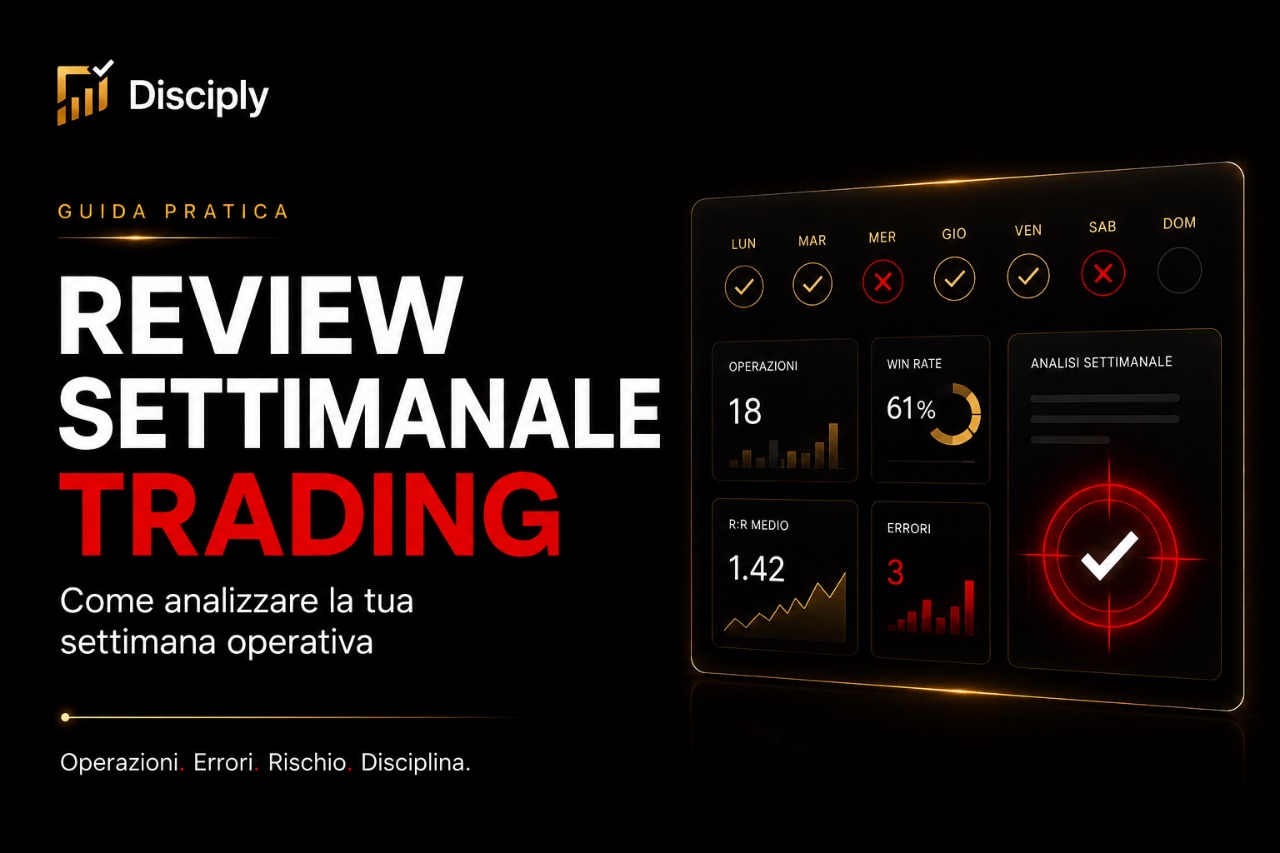
- weekly analysis of recurring errors.
This is the step that many skip. They want an advanced strategy right away, but they don't have a basic procedure yet.
Concrete example
Imagine a beginner trader observing Bitcoin during a busy day. The price goes up quickly, on social media many talk aboutbreakout and the trader is afraid of missing the opportunity.Opens a long position without defining a precise stop. The reason for the entrance is simple: "it's going up". After a few minutes the price continues to move in favor and the trader feels confident. He decides to increase the position.
Then the market retracts. Profit is reduced. The trader does not close because he thinks the price will go back up. The movement continues against him. At that point closing would mean accepting a lossbigger than expected. He then decides to wait.
The problem isn't just that the trade went bad. Problem is, there wasn't a plan.
A more correct behavior would have been different:
- first identify the technical reason for entry;
- avoid entering only for fear of losing movement;
- define a stop loss before the click;
- determine the size of the position according to the risk;
- do not increaseand the position only because the trade is temporarily profitable;
- record the reasons for the operation.
If the trader had written before the entry: "I enter because the price has broken a resistance, maximum risk X, stop below this level, I exit if the price falls within the range", he would have had a decision-making basis.
Even if the trade ended in a loss, it would still be measurable. Without a plan, however, there is only onefeeling: "I was wrong". But you don't understand what was really wrong.
In online trading, this difference is huge. An untraced error tends to repeat itself. A recorded error can become improvement material.
How a trading journal can help
A trading journal is not only used to record entries and exits. It serves to understand how the trader makes decisions.For those starting from scratch, the journal is useful because it forces you to slow down. Before opening a trade, writing down the reason for entry forces the trader to wonder if he is following a plan or just an impulse.
A good trading journal should record at least:
- traded instrument;
- direction of the operation;
- time of entry and exit;
- reason for entry;
- expected risk;
- final result;
- compliance withplan;
- emotions before, during and after the trade;
- main error, if any;
- operational lesson.
This data helps to see patterns that would be invisible from memory.
For example, a trader may find that he loses especially when he trades after two consecutive stops. Or that he gains when he waits for precise confirmations, but loses when he anticipates the entry. Or again that the problem is not the strategy, but the trop sizelarge number of positions.
The journal also helps to separate performance and behavior. Two traders can close the same loss, but with completely different decision-making quality.
The first followed the plan, complied with the stop and managed the risk. The second entered on impulse, increased the position and closed out of fear. The economic result may look similar, but the operating value is different.
Without journaling, thisdifference is lost. With a journal, on the other hand, the trader can measure whether he is really improving.
This is especially important for beginners. At the beginning you don't just need to know how much you gain or lose. You need to understand how you get to that result.
/Where does Disciply/ come into play?
Disciply comes into play right here: giving structure to the trader's trading process.When a beginner starts trading online, the risk is to focus only on the execution platform. But the platform is used to open and close trades. It does not always help to understand whether those operations were taken with discipline, method and risk control.
Disciply can help by focusing on operational behavior. It is not limited to the idea of marking a trade, but pushes the trader to observe thetheir own process.
The practical value lies in some habits:
- record operations instead of relying on memory;
- assess whether the input was consistent with the plan;
- check the risk taken;
- recognize repeated errors;
- distinguish valid trades from impulsive trades;
- create a basis for analysis to improve over time.
This does not eliminate the risk of trading. No tool can do this, but it can helpand the trader not to trade in the dark.
For those starting from scratch, the most important thing is not to look like an expert. It's building order. If every trade is tracked, analyzed, and linked to a motivation, the trader starts to see their behavior more lucidly.
Disciply can become useful precisely because it transforms trading from a sequence of isolated operations to an observable process. And an observable process can be runtto.
FAQ
What is online trading in simple words?
Online trading is the activity of buying or selling financial instruments through a digital platform, trying to get a result from price movements. It may concern forex, stocks, crypto, indices, commodities and other instruments. It is not risk-free and does not guarantee earnings.
What is the difference between buying and selling in trading?Buying means opening a long position, that is, betting on a possible price increase. Selling means opening a short position, that is, trying to benefit from a possible fall in price. Either way, if the market moves against the position, the trader can lose money.
Is online trading suitable for those who start from scratch?
It can also be studied by those who start from scratch, but should not be approached superficiallyà. Before using real money it is important to understand platforms, instruments, risk, leverage, stop management and operating method. Starting unprepared increases the risk of impulsive errors.
How much capital does it take to get started?
There is no one-size-fits-all figure. The point is not just how much capital you have, but how it is managed. Even with small amounts, serious mistakes can be made if excessive leverage is used or if thel risk. Before capital you need a clear loss management rule.
Can you trade without strategy?
Technically you can open a trade even without strategy, but it is not a serious approach. Without a logic of entry, exit and risk management, the trader cannot assess if he is improving or if he is just reacting to the market.
Why is it important to keep a trading journal?
Because it allows you to understand what's nextand really into operations. The journal helps you see recurring errors, impulsive behaviors, risk issues, and differences between planned trades and random trades. Without tracking, the trader risks repeating the same mistakes without realizing it.
/Conclusion/Online trading should not be seen as a shortcut, but as a high-risk decision-making activity. The technical part is just the beginning: opening a position is easy, managing it with method is much more difficult.
Those starting from scratch should first focus on the basics: understanding financial instruments, distinguishing buy and sell, knowing risk, avoiding excessive leverage, using an operational plan and tracking every decision.
The marketato does not reward those who click more. A beginner trader should not immediately try to trade as much, but to trade better. This means reducing random entries, defining risk before profit, and learning from every trade.
The trading journal therefore becomes a fundamental tool. Not because it makes every trade winning, but because it makes the process visible. And when the process becomes visible, it can be analyzed, correctedor is improved.
Key Points
- Online trading is buying or selling financial instruments through digital platforms.
- Trading does not mean looking for easy money, but making decisions with real risk.
- Forex, stocks, crypto, indices and commodities have different characteristics and risks.
- Before using real money you need method, risk management and emotional control.
- A tradejournal helps you understand not only how much you gain or lose, but how you make decisions.
final report
If you're starting to trade online, don't just start with the chart or the platform. Start with your process.Track trades, write why you enter, measure risk, review mistakes, and learn to distinguish a valid decision from an impulsive choice. Disciply was created to help traders build this structure: fewer random trades, more operational awareness, and a clearer review of their behavior in the markets.
Related articles
Share article
Disciply
Want to take trading seriously?
Reduce improvisation and impulsive mistakes with checklists, entry reasons, and trade reviews.
Turn every trade into a clear, consistent, measurable process.
Process before outcome.
Start with Disciply
Comments
Latest comments
All comments