Inside this article
Introduction
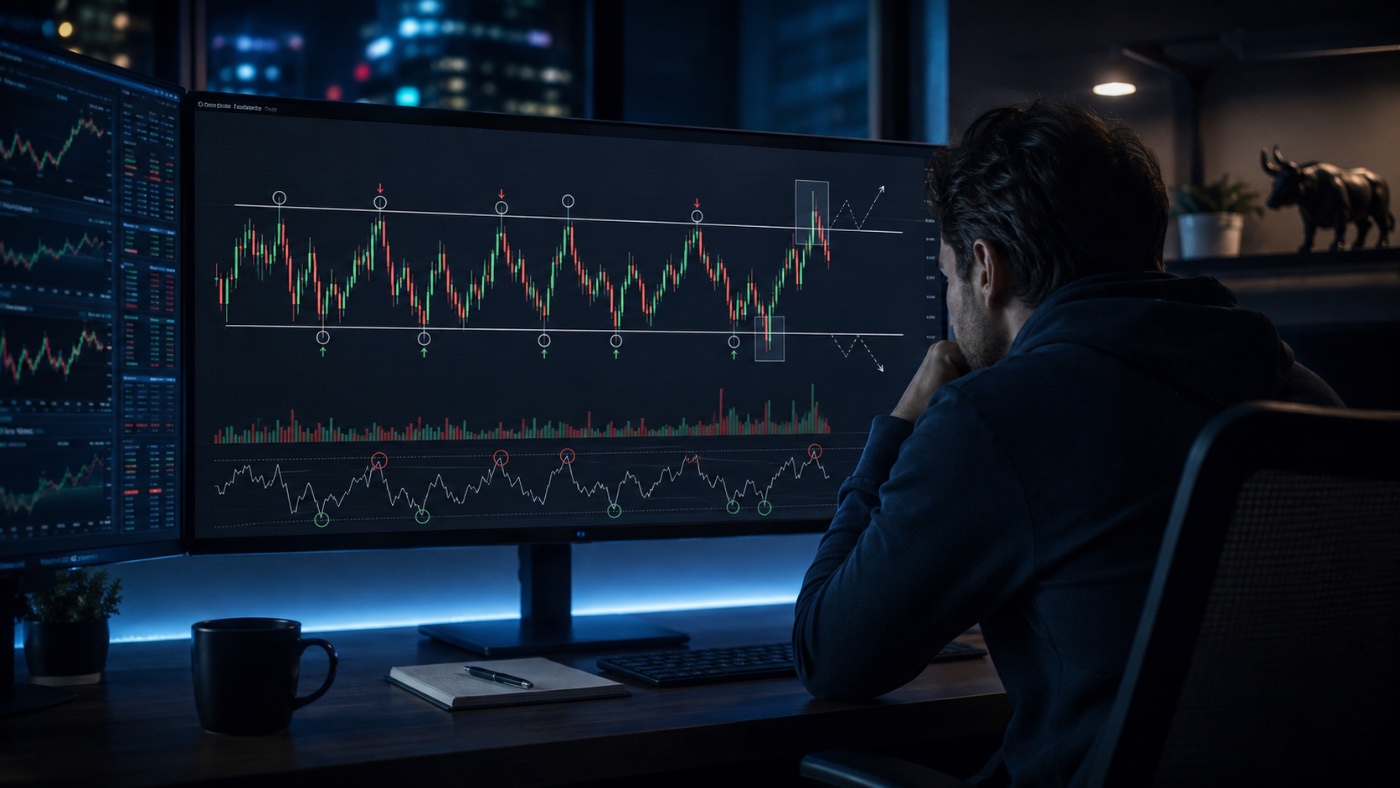
Trading without setup means opening operations even when the strategy conditions are not really present.
The chart is open, the market moves and you feel you should do something. Thus a mediocre area becomes interesting, a candle becomes a confirmation and a random movement is transformed into an opportunity.
The problem is not finding enough trade. It is not able to accept that, at some times, the correct trade does not exist.
The real problem
Many traders associate a production session with the number of operations performed.
If they spend an hour in front of the chart without entering, they perceive that time as wasted. They then begin to unconsciously lower the setup criteria.
But observing the market without opening positions can be an operational decision. A method also serves to determine when not to participate.
Because it happens
Expected and uncertainty create discomfort. The more time you spend in front of the chart, the more the temptation to find something to betray.
To this you add boredom, desire to profit, need to recover a negative day or simple habit to click.
The result can become impulsive trading: no longer wait until the market meets your conditions, but change the conditions until you find a reason to enter.
The most common errors
A frequent error is to transform partial signals into complete setup.
Another is to continue changing timeframes or tool until something interesting appears.
Then there is the trade “just to try”: maybe reduced size, low conviction and no true identified advantage. Although small, it remains a trade off trial.
What to do in practice
Define before the session what conditions should be present.
A checklist before entry makes the decision less interpretable: setup, confirmation, invalidation and risk must be clear before click.
If essential elements are missing, you should not find an alternative justification. You must recognize that there is no trade.
Example concrete
Trader A normally requires three conditions to enter. After an hour without opportunities he sees only one, but he still opens because “the movement seems to leave”.
During the day he repeats behavior three times.
Trader B uses the same criteria. No setup reaches the expected conditions and ends the session with zero operations.
Trader B has not lost three occasions. He avoided three operations that didn't belong to his method.
How a trading journal can help
In the journal separates trades with full setup from forced ones.
Record number of confirmations, reason of entry, time spent before the trade, emotional status and compliance with the rules.
By comparing the results you can check how much open operations affect without sufficient conditions. A trading journal is used to measure this difference.
Where does Disciply
Disciply can connect operations, journals and behavior to distinguish what belongs to the process from what comes from the impulse.
Recording motivations, discipline and performance allows you to understand if certain moments of the day, operational sequences or emotional states increase the frequency of trade without setup.
The goal is not to find more inputs, but to better understand what you are actually doing.
FAQ
**A day without trade is a lost day?
No. If the setup doesn't appear, staying out can mean you've properly respected the plan.
**How do I know if I'm forcing a setup? *
Compare entry with the rules defined before the session. If you have to reinterpret them to justify the trade, it is an important signal.
**I have to look for another market if I can't find opportunities?
Only if your trial predicts. Always looking for new tools only to find something to betray can increase improvisation.
Conclusion
Trading without setup transforms the wait from operating filter to problem to be eliminated.
You're not paid to always be on the market. If conditions do not exist, inventing a trade does not create an advantage.
Key points
- Not every movement is a setup.
Zero trade can be a correct result.
- The boredom can lower the entry criteria.
- The conditions must be defined before the session.
- The journal allows to measure how much forced trade costs.
/ Final CTA
Before the next entrance, ask yourself: the setup was already there or I started seeing it because I wanted to make a trade?
Related articles


Share article
Disciply
Want to take trading seriously?
Reduce improvisation and impulsive mistakes with checklists, entry reasons, and trade reviews.
Turn every trade into a clear, consistent, measurable process.
Process before outcome.
Start with Disciply
Comments
Latest comments
All comments